
[ad_1]
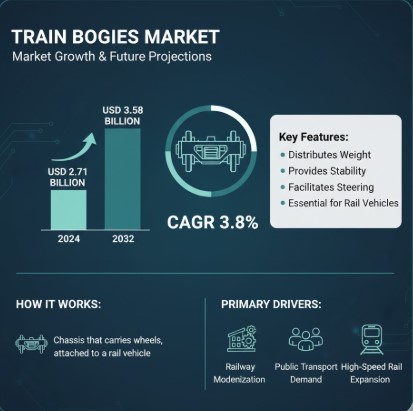
What are Train Bogies?
- Distribute vehicle weight evenly across axles while maintaining stability
- Absorb shocks and vibrations through primary/secondary suspension layers
- Enable smooth navigation through curves and track irregularities
- Support propulsion and braking systems in modern rolling stock
- Primary interviews with bogie OEMs and rail operators
- Detailed examination of 30+ ongoing rail projects worldwide
- Comparative assessment of material science advancements
- Bottom-up market modeling with 3 verification checkpoints
- Where the highest-value opportunities exist across different bogie types
- How regulatory changes impact regional market dynamics
- Which technological innovations deliver competitive advantage
- Lightweighting: Composite materials now reduce bogie weight by 15-20% compared to traditional steel designs
- Predictive Maintenance: IoT-enabled vibration sensors cut unplanned downtime by up to 40%
- Energy Efficiency: Regenerative braking integration in EMU bogies decreases power consumption by 25%
Market Challenges
- Supply Chain Complexities: Special alloy steels (Grade 350W) face 12-16 week lead times, delaying production cycles
- Technical Certification Requirements: New bogie designs require 18-24 months for TSI/UIC approval in Europe
- Skills Shortage: 30% of European bogie manufacturers report difficulties finding qualified welding specialists
Emerging Opportunities
- Metro System Expansions: 48 cities worldwide are constructing new metro lines by 2025
- High-Speed Rail Proliferation: Over 15 countries have active HSR projects exceeding USD 500 million
- Aftermarket Services: Predictive maintenance solutions for existing fleets represent a USD 800+ million service opportunity
Regional Market Insights
- Asia-Pacific: Accounts for 42% of global demand, driven by China’s CRRC and India’s Metro Rail projects
- Europe: Leads in technological innovation with Alstom’s OMEGA bogie and Siemens’ SF5000 designs
- North America: Focused on heavy-haul freight bogies with 35-ton axle load capacity
- Middle East/Africa: Emerging as growth markets with Dubai Metro expansions and Nigeria’s Lagos Rail Mass Transit
Market Segmentation
- 2-axle Bogies (Dominating 68% market share)
- 3-axle Bogies
- Articulated Bogies
- Passenger Trains (High-speed, Metro, Regional)
- Freight Wagons (Container, Hopper, Tank)
- Special Purpose (Maintenance, Military)
- Cast Steel Bogies (Traditional standard)
- Alloy Steel Bogies
- Composite Material Bogies (Emerging segment)
Competitive Landscape
- Alstom’s acquisition of Bombardier Transportation (2021)
- CRRC’s establishment of European R&D centers
- Kawasaki’s partnerships with Indian Railways
- CRRC Corporation Limited
- Alstom S.A.
- Siemens Mobility
- Kawasaki Heavy Industries
- Wabtec Corporation
- Titagarh Wagons
- Amsted Rail
Report Deliverables
- Market size estimations (2024-2032) with 3 methodology cross-checks
- Market share analysis of top 15 bogie manufacturers
- Emerging technology assessment (digital twins, additive manufacturing)
- Detailed regulatory impact analysis across 25 countries
About Intel Market Research
- Real-time competitive benchmarking
- Technology adoption tracking
- Supply chain analysis
- Over 300 industrial sector reports annually
[ad_2]
Source: PR News Releaser
Train Bogies Market Outlook: USD 3.58 Billion by 2…