
[ad_1]
Introduction
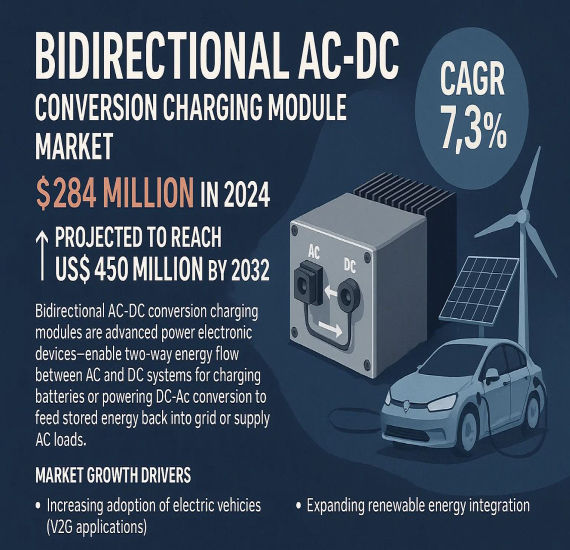
The global Bidirectional AC-DC Conversion Charging Module Market, valued at USD 284 million in 2024, is projected to reach USD 450 million by 2032, expanding at a 7.3% CAGR through 2025–2032. Demand is rising as electrification, renewable adoption and grid-modernization converge, forcing EV charging, microgrids and utilities to deploy bidirectional power electronics that enable vehicle-to-grid services, backup power and active grid support.
𝐃𝐨𝐰𝐧𝐥𝐨𝐚𝐝 𝐅𝐑𝐄𝐄 𝐒𝐚𝐦𝐩𝐥𝐞 𝐑𝐞𝐩𝐨𝐫𝐭: https://semiconductorinsight.com/download-sample-report/?product_id=117988
Emerging Trends Shaping the Market
- Mainstreaming V2G and V2X services — Automakers, fleet operators and utilities are piloting vehicle-to-grid (V2G) and vehicle-to-everything (V2X) business models to monetize parked EVs as distributed energy resources. Charging modules that support bidirectional power flow are now evaluated as strategic grid assets rather than optional features.
- Efficiency and power-density gains — Advances in wide-bandgap semiconductors (SiC, GaN), modular inverter topologies and thermal management are pushing conversion efficiencies above 95% while shrinking form factors — critical for residential chargers and commercial fast-charging stations.
- Integration with renewable storage and microgrids — Bidirectional modules are increasingly used to buffer solar and wind intermittency, support islanding in microgrids, and provide black-start capabilities for critical facilities, expanding use cases beyond EVs.
- AI-enabled grid interaction — Intelligent control layers and machine learning algorithms optimize charge/discharge scheduling for revenue stacking (energy arbitrage, frequency regulation, demand charge reduction) while preserving battery health.
- Regional deployment concentrates in Asia-Pacific — High EV adoption and concentrated manufacturing in China, South Korea and Taiwan account for a majority of installations, accelerating local supply chains and scale economics for module producers.
Key Market Drivers and Growth Factors
- Rapid EV adoption (≈65% market share): Electric vehicles are the dominant application, driving demand for charging ecosystems that go beyond one-way energy flow.
• Need for grid flexibility: Increasing renewable penetration requires bidirectional solutions to balance supply–demand and provide ancillary services.
• Policy incentives and utility programs: Time-of-use tariffs, grid support incentives and pilot V2G programs accelerate commercial deployments.
• Efficiency requirements for ultrafast charging: To support higher power levels with acceptable losses, system designers prefer advanced bidirectional converters.
• Regional concentration of manufacturing and deployment: Asia-Pacific leadership in EV production and adoption shapes investment and R&D priorities.
𝐆𝐞𝐭 𝐅𝐮𝐥𝐥 𝐑𝐞𝐩𝐨𝐫𝐭 𝐇𝐞𝐫𝐞: https://semiconductorinsight.com/report/bidirectional-ac-dc-conversion-charging-module-market/
Strategic Developments by Key Players
Market participants are combining power electronics innovation with ecosystem partnerships. Notable companies include TDK Corporation, Siemens AG, Advantics, Accraine, ShenZhen Winline Technology, Shenzhen Honor Electronic, AcePower, Suzhou Lumlux, Infypower and Imaxpower. Strategic moves range from joint ventures with automakers and utilities to product launches focused on modular, scalable architectures. Several firms are also offering software stacks and grid-service marketplaces to accelerate monetization for fleet owners and aggregators.
Segment Analysis: Who Leads the Market?
By Power Range: The 15–30 kW segment leads residential and light commercial use, while 30–60 kW and >60 kW modules address fleet depots and fast-charging hubs.
By Application: EVs dominate; renewable integration, UPS systems and microgrids are fast-growing secondary markets.
By Voltage Level: Low-voltage solutions remain common for homes and small businesses; medium- and high-voltage products are emerging for utility-scale and depot applications.
By End User: Automotive and utility sectors represent the largest end users; commercial fleets and commercial/residential aggregators are significant growth pockets.
𝐃𝐨𝐰𝐧𝐥𝐨𝐚𝐝 𝐅𝐑𝐄𝐄 𝐒𝐚𝐦𝐩𝐥𝐞 𝐑𝐞𝐩𝐨𝐫𝐭: https://semiconductorinsight.com/download-sample-report/?product_id=117988
Technological Advancements Impacting Growth
Can next-gen semiconductors and control software unlock new value? Yes — wide-bandgap devices reduce switching losses and enable higher switching frequencies, which shrink passive components and boost power density. Paired with advanced thermal designs and AI-driven control, these improvements lower system cost per kW and broaden bidirectional deployment across more use cases.
Why This Report Matters
This market study delivers actionable market sizing (2024–2032), vendor benchmarking, technology roadmaps and segmentation that help OEMs, utilities, policymakers and investors prioritize product development, deployment strategies and partnership models. It clarifies where technical trade-offs and regulatory levers will most influence commercialization timelines and ROI.
𝐆𝐞𝐭 𝐅𝐮𝐥𝐥 𝐑𝐞𝐩𝐨𝐫𝐭 𝐇𝐞𝐫𝐞: https://semiconductorinsight.com/report/bidirectional-ac-dc-conversion-charging-module-market/
Conclusion
As transportation electrification and grid modernization progress in parallel, bidirectional AC-DC charging modules will shift from niche pilots to core infrastructure for energy flexibility. Vendors that couple high-efficiency hardware with interoperable controls, reliable safety certification and utility partnerships will capture the largest share of a market that sits at the intersection of mobility, energy and smart-grid transformation.
Source: PR News Releaser